

Problem-Solution Fit: A Practical Guide for Australian Startups
What Problem-Solution Fit actually means
Problem-Solution Fit (PSF) is the stage where you have evidence that:
- A specific group of people has a real, frequent problem worth solving.
- Your proposed solution is one they would genuinely use, and ideally pay for, to solve it.
PSF sits between "I have an idea" and "I have a product people want" (Product-Market Fit). It is the cheapest stage to get wrong and the most expensive stage to skip. Most Australian startups that fail do not fail because they built the wrong product — they fail because they built a real product for a problem that either didn't exist, wasn't painful enough, or belonged to a customer who couldn't pay.
The critical mental shift: PSF is not about your solution. It is about the problem. You cannot validate a solution for a problem you haven't validated first.
Where PSF fits in the startup journey
Idea → Problem-Solution Fit → Product-Market Fit → Growth → Scale
        (this guide)            (traction, retention)
Ash Maurya's framing is useful: before PSF, you are searching for a problem worth solving. After PSF, you are building a solution worth paying for. After PMF, you are scaling a business worth building.
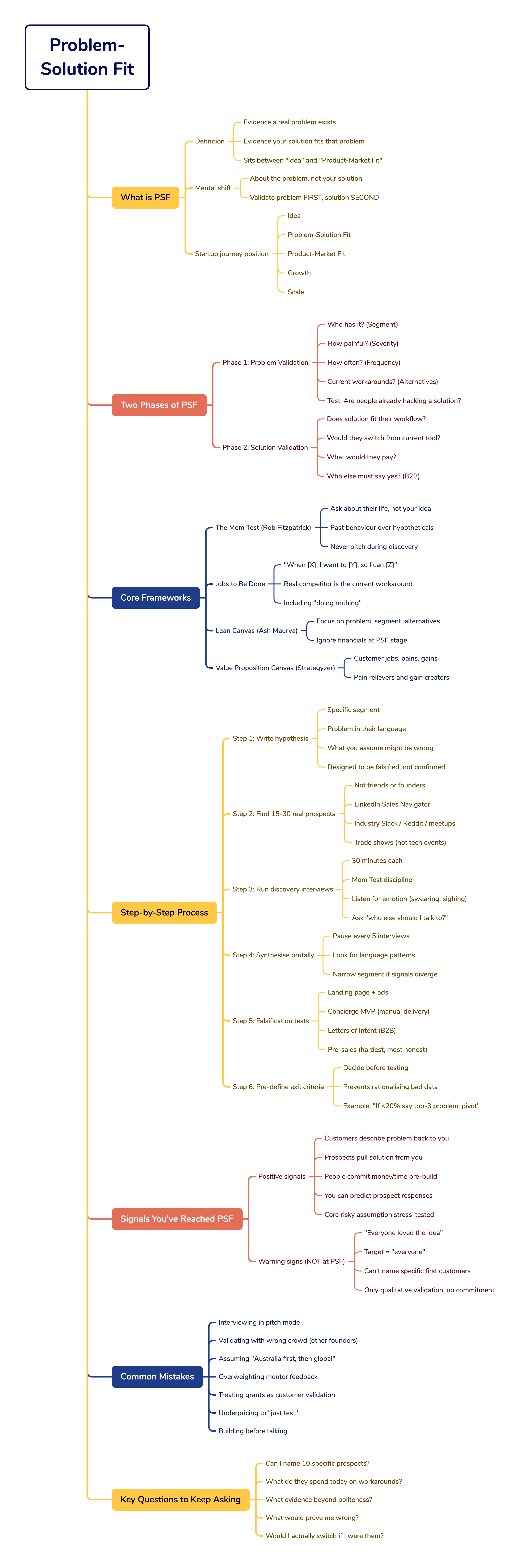
The two phases of PSF
Phase 1: Problem Validation
You are answering four questions:
- Who exactly has this problem? (Segment)
- How painful is it for them? (Severity)
- How often does it occur? (Frequency)
- What are they doing about it today? (Alternatives)
If you can't name a specific person, at a specific company, with a specific trigger event, doing something specific and inadequate about this problem today, you have not validated it. "Small businesses struggle with bookkeeping" is not a validated problem. "Sole-trader tradies in South-East Queensland who do under $200K revenue lose 3–5 hours a weekend manually matching invoices to bank transactions in Xero because their accountant only reconciles quarterly" is getting closer.
The test for a real problem worth solving: people are already spending time, money, or emotional energy on an inadequate workaround. If nobody has hacked together a solution with spreadsheets, duct tape, or an offshore VA, the problem probably isn't painful enough.
Phase 2: Solution Validation
Only once Phase 1 is done. You are answering:
- Does the proposed solution actually fit how the customer works?
- Would they switch from their current workaround?
- What would they pay, and when would they pay it?
- Who else needs to say yes for them to adopt it? (Especially in B2B — procurement, IT, compliance)
This phase uses low-fidelity tools: mockups, clickable prototypes, landing pages with pre-orders, concierge MVPs where you manually deliver the value before building software. The goal is not to build — it is to get falsifiable evidence that people will commit something (money, time, a signed LOI) before you build.
Core frameworks worth knowing
The Mom Test (Rob Fitzpatrick). The single most useful book on customer interviewing. Core principle: ask about their life, not your idea. Never pitch. Ask about past behaviour, not hypothetical future behaviour. "Walk me through the last time this happened" beats "would you use something that..." every time. Australians are especially prone to giving encouraging but useless feedback, so Mom Test discipline is non-negotiable here.
Jobs to Be Done (Clayton Christensen, refined by Bob Moesta). People don't buy products; they "hire" them to make progress in a specific circumstance. Frame your problem as: "When [situation], I want to [motivation], so I can [expected outcome]." This reframes competition — your real competitor isn't another app, it's whatever the customer currently "hires" (including doing nothing).
Lean Canvas (Ash Maurya). One-page business model focused on problems, customer segments, and unique value proposition rather than financial projections. For PSF, focus obsessively on the top-left: problem, customer segment, and existing alternatives. Everything else is premature.
The Value Proposition Canvas (Strategyzer). Maps customer jobs, pains, and gains against your product's pain relievers and gain creators. Useful as a structured way to check whether your solution actually maps to validated problems, not ones you assumed.
A practical step-by-step process
Step 1: Write your problem hypothesis
Before you talk to anyone, write down what you believe. One or two sentences each:
- Who has the problem (specific segment, not "SMEs" or "millennials")
- What the problem is (in their language, not yours)
- Why do you believe it's painful
- What do you think they do about it today
- What you're assuming could be wrong
This becomes the thing you are trying to falsify, not confirm. Founders who try to confirm hypotheses hear what they want to hear. Founders who try to falsify them actually learn.
Step 2: Find 15–30 people in the segment
Not friends. Not "people who said they'd help." Actual members of the specific segment you named. LinkedIn Sales Navigator, industry Slack communities, Reddit subs (r/AusFinance, r/smallbusiness, r/Entrepreneur), professional associations, and cold email work. In Brisbane specifically: River City Labs, The Precinct at Fortitude Valley, Fishburners QLD, and industry meetups on Luma or Meetup. For B2B, attend the one trade show where your customers actually go, not the tech ones where founders hang out.
Step 3: Run Mom Test–style discovery interviews
30 minutes each. Ask about their life and workflow, not your idea. Good opening questions:
- "Walk me through what you did last [Monday / end of month/time this thing happens]."
- "What's the most frustrating part of [the broader area]?"
- "Tell me about the last time [problem] happened. What did you do?"
- "What have you tried to fix this? What worked and didn't work?"
- "If you could wave a magic wand, what would change?" (Only after you have concrete data.)
Never describe your solution. Never ask "would you use X?" Listen for emotion — swearing, sighing, enthusiasm. Emotion is signal. Flat tone is noise. End with "who else should I talk to about this?" to compound your pipeline.
Step 4: Synthesise brutally
After every 5 interviews, pause and look for patterns. Are you hearing the same language? The same workarounds? The same trigger events? Or are you hearing wildly different things — meaning your segment is probably too broad and you need to narrow?
The harsh question: is the problem actually painful, or is it just mildly annoying? Painful problems make people take action. Mildly annoying ones don't convert, no matter how elegant your solution is.
Step 5: Run falsification tests on the solution
Now — and only now — you design low-cost tests that could prove you wrong:
- Landing page test. Describe the solution, ask for an email or a pre-order. Run small ads. Measure conversion honestly.
- Concierge MVP. Deliver the value manually, even if it doesn't scale. Canva's early team manually helped schools design yearbooks before automation existed.
- Letters of intent. In B2B, ask for a non-binding LOI. If a customer won't sign a non-binding document, they won't sign a binding one later.
- Pre-sales. Ask for real money now for delivery later. This is the hardest and most honest signal.
- Wizard of Oz prototype. Looks like a product, with you powering it in the background.
Step 6: Define your PSF exit criteria in advance
Before you run tests, decide what outcome would make you pivot. Founders who decide this after the fact rationalise bad data. Examples:
- "If fewer than 20% of interviewed prospects agree this is a top-3 problem, we pivot."
- "If we can't get 3 LOIs from target customers in 6 weeks, we pivot."
- "If pre-sale conversion is under 2%, we rethink the segment."
Signals you have actually reached PSF
You're at PSF when most of these are true:
- Customers describe the problem back to you in their own words, with more specificity than you pitched.
- Prospects pull the solution out of you rather than you pushing it onto them.
- People offer to pay, commit time, or sign something before you've built it.
- You can predict what a new prospect will say in the first 10 minutes of a call.
- Your core assumption — the one that, if wrong, kills the business — has been stress-tested, not just agreed with.
You are NOT at PSF if:
- "Everyone I talked to loved the idea" — this usually means you pitched instead of interviewed.
- Your target customer is "everyone" or a segment larger than 10 million people.
- You can't point to specific individuals who would be first customers.
- Your validation is purely qualitative with no behavioural commitment.
Common mistakes Australian founders make
Interviewing in pitch mode. You show up excited, describe your idea, and people say nice things because they're Australian and don't want to be rude. Fix: Never mention your solution in the first 5 interviews. Just ask about their world.
Validating with the wrong crowd. Other founders at Fishburners or The Precinct are not your customers (unless you're building a product for founders). They're encouraging, smart, and completely irrelevant as a validation signal.
Assuming Australia first, then global. Starting with Australia-only problem framing when your end game is global. Either validate in Australia with a problem shape you know translates, or validate directly in a larger market from day one if you can travel or run remote interviews.
Overweighting accelerator feedback. Startmate, Antler, and similar programs are invaluable, but mentor feedback is fast, confident, and often wrong in the specific case. Use mentors to sharpen questions, not to answer them. Your customers answer them.
Treating grants as validation. Receiving an Ignite Ideas Fund grant, an EMDG, or qualifying for the R&D Tax Incentive is not customer validation. It means a government panel liked your story. Only paying customers validate.
Underpricing "just to test." Selling the first version for $5 tells you nothing about willingness to pay at real prices. Anchor at the price you actually intend to charge, even if you discount explicitly for early customers.
Building before talking. The most expensive mistake. Australian tech talent is good but expensive; a single engineer's month burned building the wrong thing is $15–25K gone. A month of 30 customer interviews costs you time only.
The Australian ecosystem: what to use and when
Pre-PSF (idea stage, validating the problem)
- Founder Institute. Global pre-seed program, Australian chapters. Useful discipline for first-time founders.
- University programs. If you're affiliated: UQ Ventures (Brisbane), ACU Co-Lab (Melbourne, LaunchVic-funded), UNSW Founders, Melbourne Accelerator Program (MAP).
- Community hubs. The Precinct (Brisbane), River City Labs (Brisbane), Fishburners (multiple cities), Stone & Chalk (Sydney/Melbourne). Good for peer learning and meeting early advisors.
- Ignite Spark Program (Queensland). Up to $75,000 to develop and validate a product pre-market. Designed for your exact stage if you're based in Queensland.
Reaching PSF / early traction
- Startmate Accelerator. 12 weeks, $120K for 7% equity at a $1.5M valuation cap (recent cohort terms). The program is explicitly built around customer obsession and validation — well aligned with PSF work. Median post-program round is strong. Very selective: ~600 applications per cohort, ~19–25 companies accepted.
- Antler. "Day zero" investor. Will back you before you have a co-founder or idea. $260K for 12% after a 5-week residency and investment committee. Good if you don't have a team yet.
- Skalata Ventures (Melbourne, now also Perth). For startups approaching early revenue and targeting Series A readiness. Up to $200K initial, with follow-on potential.
- Techstars Tech Central Sydney. NSW-government-backed accelerator, $220K for 6% (recent cohorts).
- Google for Startups Accelerator: AI First (Australia). Non-dilutive, includes cloud credits — valuable if you're building AI-native products.
- Cicada Innovations (Sydney). Deep tech, med tech, agtech. Lab access and specialised support.
- Remarkable (Sydney). Accelerator with US pathway, smaller cohorts.
- muru-D. Telstra-backed, focus on AI, robotics, satellite tech.
Non-dilutive funding worth knowing
- R&D Tax Incentive (federal). 43.5% refundable offset on eligible R&D expenditure for companies with aggregated turnover under $20M. Refundable means you get cash back even if you're in tax loss, which most early-stage startups are. This is the single most important line item in the Australian startup ecosystem — if you're doing genuine experimental work with technical uncertainty, you likely qualify. Note: reforms are under discussion following the March 2026 Strategic Examination of R&D, including a proposed "premium startup stream." Watch the 2026–27 federal budget.
- Industry Growth Program (federal). For SMEs commercialising novel products; replaces the older Accelerating Commercialisation grant. Grants for post-validation, pre-scale companies.
- Export Market Development Grants (EMDG). Up to 50% reimbursement on eligible export marketing expenses. Relevant once you're exporting or preparing to.
- Ignite Ideas Fund (Queensland). Tier 1 up to $100K, Tier 2 up to $200K. For Queensland SMEs with an MVP or beyond, commercialising innovative products. As a Brisbane-based founder, this is your closest state-level grant opportunity. Currently between rounds — watch the Advance Queensland site.
- Female Founders Co-Investment Fund (Queensland). Up to $200K for women-led startups preparing for early-stage capital raise.
- NSW MVP Ventures Program. $20K–$75K for NSW-based startups; comparable to the QLD Ignite Spark.
- LaunchVic (Victoria). State-level startup agency funding various programs and accelerators.
Non-dilutive funding is free money only in the narrow sense. Grant applications take serious time, require matched contributions, and can distract from customer work. Rule of thumb: never apply for a grant you wouldn't pursue if it didn't exist. Apply for grants that pay you to do what you were going to do anyway.
Australian success stories worth studying
Canva spent years before launch on a narrower product — Fusion Books, a yearbook design tool — which was their problem-validation school. Melanie Perkins pitched 100+ investors before her Series A. The PSF lesson: Fusion Books proved the jobs-to-be-done (non-designers needing professional layouts) before the team generalised to Canva.
SafetyCulture started as a paper-checklist replacement for blue-collar site inspections. The validation was brutally specific: tradies and site managers in regional Australia were already using pen-and-paper forms. Luke Anear did the unsexy work of watching real workflows. PSF lesson: the least glamorous problems are often the best-validated ones.
Culture Amp solved employee engagement surveys for a specific buyer (HR leaders at mid-sized companies) with a specific alternative (expensive consultancy surveys done annually). The problem was well understood and already being paid for — they competed on delivery, not on the problem's existence. PSF lesson: sometimes the problem is already validated by the market; your job is to validate your specific solution fits better.
Atlassian built for developers who were also the buyers (avoiding enterprise sales), and grew without a sales team for years. Mike Cannon-Brookes has said they spent their early years obsessively reading support tickets. PSF lesson: ongoing validation doesn't stop at launch.
A 6-week PSF sprint you can actually run
Week 1 — Hypothesis & pipeline. Write problem hypothesis. Identify a specific segment. Build a list of 50 prospects to reach out to. Book 10 interviews.
Week 2 — First 10 interviews. Mom Test discipline. Notes within 1 hour of each call. Re-read after call 5 and look for surprises.
Week 3 — Synthesis & segment refinement. What patterns emerged? Narrow the segment if needed. Rewrite the hypothesis. Book 10 more interviews with a sharper target.
Week 4 — Second 10 interviews plus workaround deep-dive. Now ask specifically about current tools, hacks, and money spent today. Can you quantify the pain?
Week 5 — Solution concept & falsification test design. Sketch the solution based on validated problems. Choose one falsification test (landing page, LOI, pre-order, concierge). Build nothing except what the test needs.
Week 6 — Run the falsification test. Measure behavioural commitment, not verbal enthusiasm. Decide: proceed, refine, or pivot.
This sprint costs you six weeks and roughly $500–$2,000 in ads and tools. An engineer-led "let's just build and see" approach costs six months and $50K+. Every founder knows this intellectually. Very few live it.
The questions to keep coming back to
- Can I name 10 specific people — first name, last name, company, role — who have this problem right now?
- What are they currently spending time or money on to deal with it?
- What evidence do I have, other than people being nice to me, that they would pay?
- What would prove me wrong? Have I looked for that evidence as hard as I've looked for confirming evidence?
- If I were the customer, would I actually switch? What would have to be true?
You will find a great guide on Problem-Solution Fit on Antler Blog: https://www.antler.co/blog/problem-solution-fit