

Choosing Your Market Scope
When building a startup, one of the earliest decisions you'll make as an Australian founder is who you're building it for. More specifically: where do they live? Australia only, Australia plus New Zealand, or the world from day one?
This guide walks through the three options, the trade-offs associated with each, and a practical framework for aligning your scope with your company.
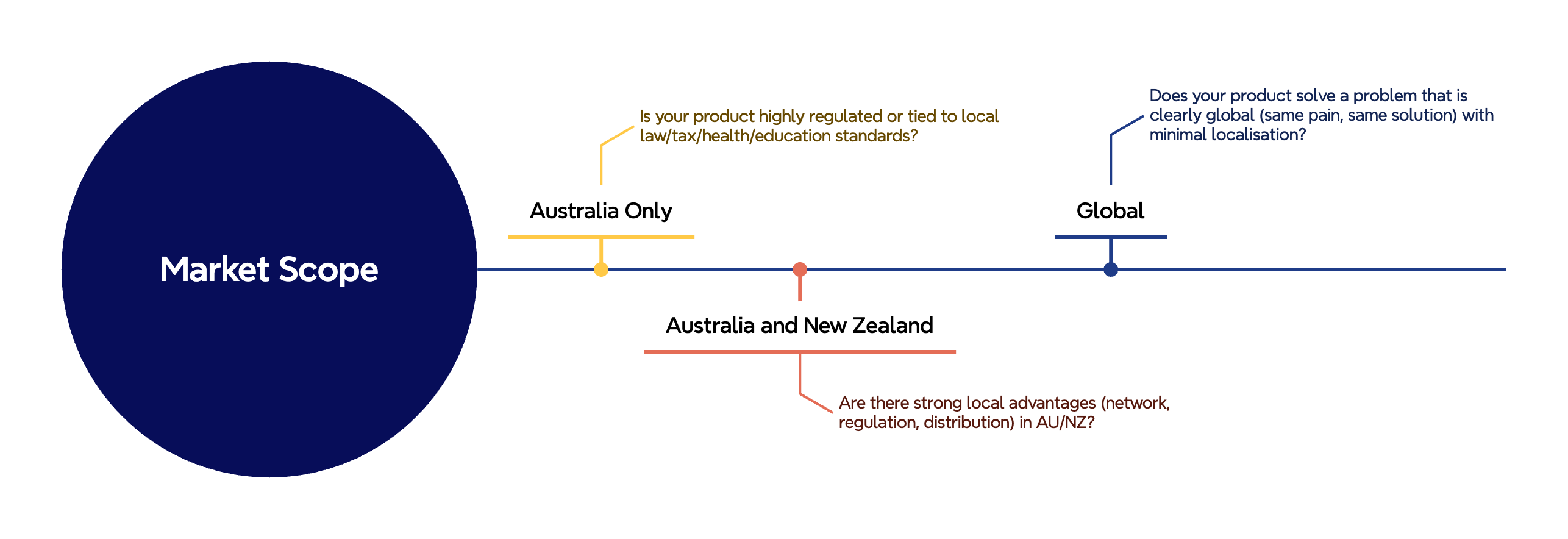
Option 1: Australia Only
There are genuinely good reasons to build an Australia-only company. Heavily regulated industries such as health, finance, superannuation, and legal services often have structural moats created by local compliance requirements. Government customers are inherently local. Anything involving property, payroll, insurance, or tax is deeply entangled with Australian law. Marketplaces benefit from local density long before they benefit from geographic breadth, so focusing on winning one Australian city at a time can beat a thin global presence. Service businesses that require local relationships, field operations, or physical inventory also tend to favour a concentrated footprint.
The trade-offs are real. Australia has roughly 27 million people, which puts a ceiling on the total addressable market for most consumer and SMB plays. A category-dominant AU-only business might exit somewhere between $50 million and a few hundred million dollars. It is an excellent outcome for founders and early employees, but rarely enough to generate the returns venture funds need. This is why many Australian VCs will either pass on AU-only pitches or push founders to articulate a credible path beyond. If you plan to bootstrap, raise a modest seed round, and run profitably, AU-only can be the right call. If you plan to raise institutional venture capital and target a venture-scale outcome, you'll likely need a bigger canvas.
Option 2: Australia and New Zealand
Adding New Zealand is the most natural extension an Australian founder can make. The Closer Economic Relations agreement significantly reduces trade friction; the two countries share a language, legal traditions, and broad cultural sensibilities.
That said, "Australasia" as a market unit has both its uses and its limits. New Zealand adds about 5 million people to your potential customer base, which is meaningful for consumer products and e-commerce but not transformative for the economics of a venture-backed software business.
Option 3: Global from Day One
"Global from day one" is increasingly the default posture for Australian software startups, and for good reason. Software distribution costs almost nothing at the margin, English-speaking markets are enormous, and the Australian VC community is strongly oriented around founders who can credibly build a global category leader. Canva, Atlassian, SafetyCulture, Culture Amp, Linktree, and Immutable all sold internationally early on; very few Australian venture outcomes in the past decade have come from local champions staying local.
Selling to English-speaking markets (the US, UK, Canada, plus AU/NZ) via a self-serve website is one thing. A product and pricing page in English with a credit card checkout covers most of what you need. Building a genuine US sales presence is different: it typically involves hiring senior US-based go-to-market talent, restructuring the company as a Delaware C-Corp to accept US venture capital, and eventually relocating at least one founder. Expanding into the EU introduces GDPR, data residency, and localisation. APAC is a patchwork of distinct markets, each with its own languages, distribution channels, and buying norms.
Global from day one makes most sense for developer tools, horizontal SaaS, AI products, marketplaces without strong local network effects, and anything where the best customers are concentrated outside Australia.
Australian-Specific Factors to Weigh
A few features of the Australian context affect this decision in ways that founders elsewhere don't face.
The R&D Tax Incentive is one of the strongest government supports for technical startups worldwide, offering a significant refundable offset on eligible R&D spending for smaller companies. Critically, this applies to engineering work done in Australia, regardless of where customers live, meaning you can build here and sell globally while enjoying a meaningful capital-efficiency advantage. Export-focused programmes, such as the Export Market Development Grants scheme, can also help offset the costs of reaching overseas customers. Specific program parameters change over time, so check current details with Austrade or a specialist advisor. The general picture is that the Australian government actively subsidises building locally and selling globally.
A Practical Framework
Rather than debating scope in the abstract, work through a few concrete questions.
First, what is the Australian TAM for your specific product, sized honestly? If the number is below a few hundred million dollars in annual revenue across the entire domestic market, AU-only is unlikely to support venture-scale ambitions, even with complete dominance.
Second, is there a structural reason your product has to be Australian, like regulation, language, physical presence, or local relationships? If yes, AU is probably correct, and you should lean into that moat.
Bootstrap and revenue-funded businesses have much more freedom to stay local. Venture-funded businesses almost inevitably face pressure to scale geographically.