

The Co-founder Selection, Roles, and Responsibilities
Choosing a co-founder is one of the highest-leverage decisions you will make. Investors, operators, and researchers consistently rank "co-founder conflict" among the top reasons early-stage startups fail, ahead of product problems and running out of money. The person (or people) you choose will shape your culture, your cap table, and your daily experience for years.
This guide walks through how to decide whether you need one, how to find the right person, how to divide responsibilities, and how to structure the relationship so it survives stress.
1. Do You Actually Need a Co-founder?
Before searching, be honest about the question. Solo founders can and do succeed (Jeff Bezos, Pieter Levels, Melanie Perkins started Canva solo before bringing on co-founders). But having the right co-founder typically increases your odds, because:
- The workload of an early-stage startup is crushing for one person.
- Complementary skills let you move faster across product, sales, and operations.
- Emotional support during the inevitable low points is hard to overstate.
- Many investors explicitly prefer 2–3 person founding teams.
That said, the wrong co-founder is strictly worse than no co-founder. A bad match burns equity, time, trust, and often the company itself. If you cannot find someone who clears the bar below, go solo and hire early employees instead.
2. What to Look For
Non-negotiables
- Trust and integrity. You will hand this person access to your bank accounts, your cap table, and your reputation. If you have any doubt here, stop.
- Shared values. How you treat employees, customers, and each other when things go wrong. Value mismatch shows up late and breaks companies.
- Aligned vision and ambition. Are you both building a billion-dollar company? A lifestyle business? A stepping stone? These are all valid, but they must match.
- Complementary, not identical, skills. Two engineers with no sales ability is a common failure pattern.
- Resilience. How do they behave when things are hard, ambiguous, or embarrassing?
- Ability to disagree productively. You will disagree constantly. Can they hold a position, change their mind with new evidence, and move on without resentment?
Strong positives
- A prior working relationship (not just friendship) — ideally, you've shipped something together.
- Different networks from yours (doubles your reach for hiring, fundraising, and customers).
- Financial runway to commit full-time without panic.
- Domain expertise relevant to your market.
- A track record of finishing things.
Red flags
- Vague commitment ("I'll come on full-time once you raise").
- Unwillingness to have direct conversations about money, equity, or roles.
- History of leaving things when they get hard.
- Big life constraints they haven't disclosed (impending relocation, other obligations, health issues they need you to know about).
- Mismatch on time horizon — one person wants to sell in three years, the other wants to run it for twenty.
- Can't take or give direct feedback.
- You've never seen them under stress.
3. Where to Find Co-founders
In rough order of success rate:
- Former colleagues. You've already seen their work, their judgment, and how they behave under pressure. This is the gold standard.
- Classmates. University, grad school, or program cohorts where you've collaborated closely.
- Accelerators and fellowships. YC, Techstars, On Deck, and Entrepreneur First explicitly help match founders.
- Co-founder matching platforms. Y Combinator's Co-Founder Matching platform is free and widely used. CoFoundersLab and similar also exist.
- Communities. Open source projects, industry meetups, hackathons, Slack/Discord communities where you've built a reputation.
- Warm intros. Mutual friends, former managers, investors you trust.
Avoid cold strangers from the internet unless you then do the full vetting process below. In most cases, avoid your spouse or immediate family. It's not impossible, but it doubles the stakes of every disagreement.
4. Vetting: Dating Before Marriage
Do not skip this. The pattern that works:
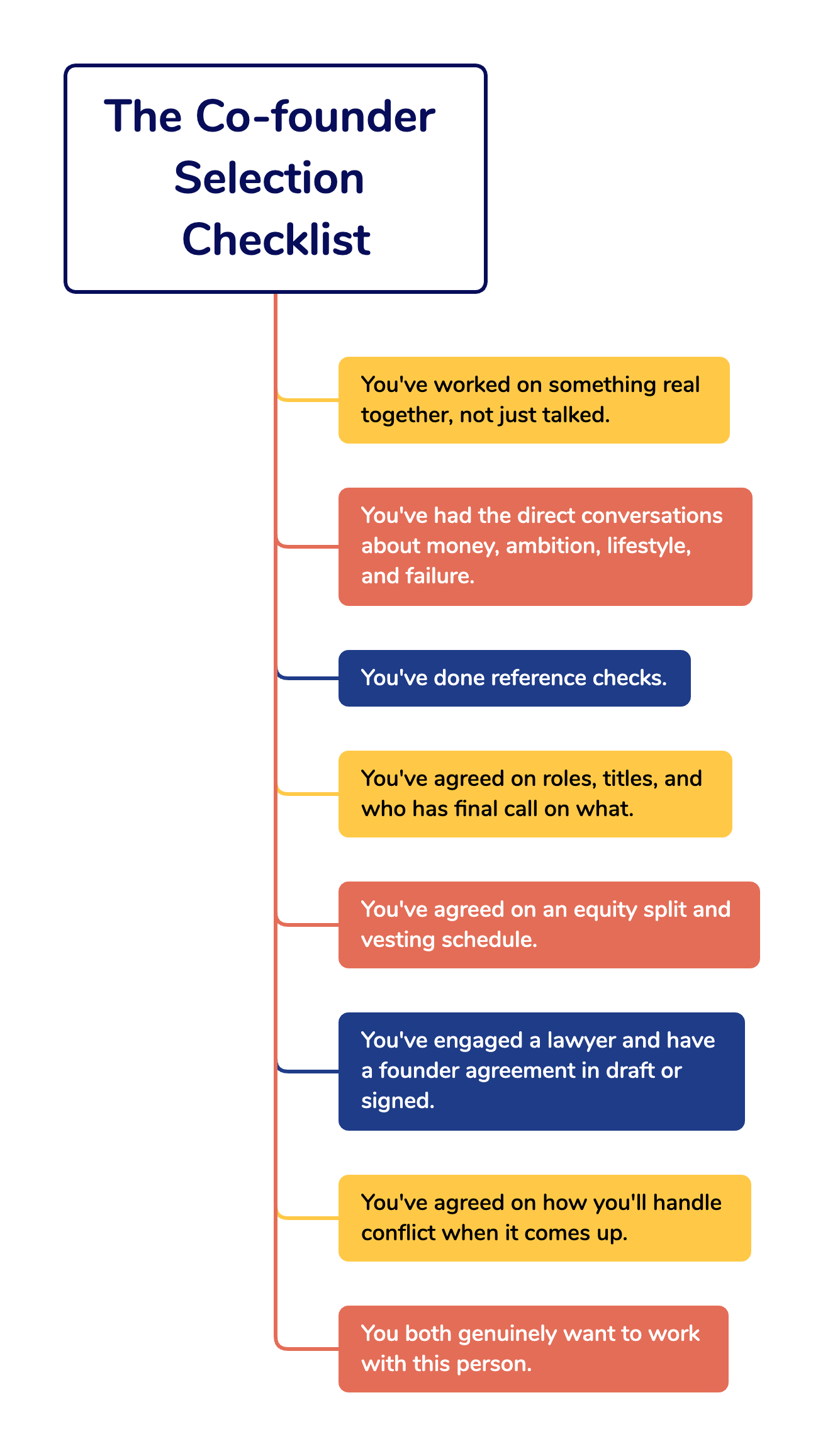
- Work on something real together for at least a few weeks, ideally longer. A prototype, a weekend project, a paid consulting gig. You learn more from one tough sprint than from ten coffee chats.
- Have the hard conversations explicitly. Not hinted at, not assumed — actually said out loud and, ideally, written down. Topics:
- How much money each of you has, and how long you can go without a salary.
- What "success" means to each of you — financially, personally, and on what timeline.
- What happens if the company fails? What happens if one of you wants out?
- Location, family plans, willingness to relocate, travel tolerance.
- How you each handle conflict.
- Past failures and what you learned from them.
- Reference checks. Talk to two or three people who have worked closely with them. Ask specifically about conflict and about follow-through.
- Observe them under stress. A tough customer call, a product outage, a missed deadline. How they act when things are going badly tells you more than a hundred pitches about how things will go well.
5. Roles and Responsibilities
Common two-founder structures
The most common patterns for tech startups:
- CEO + CTO — the default for software startups. CEO owns vision, fundraising, sales, hiring. CTO owns product and engineering.
- CEO + COO — common in operations-heavy or marketplace businesses. COO owns execution and internal systems.
- CEO + CPO — product-led companies where the product vision is the core of the business.
For three-founder teams, a CEO + CTO + (COO or CPO or CRO) split is typical.
Principles for dividing work
- Single DRI per domain. Every important area (product, engineering, sales, marketing, finance, hiring, legal) has exactly one directly responsible individual. Two owners mean no owner.
- There is one CEO. Equal equity does not mean equal authority on every decision. Someone has the final call when you can't agree. This is not a threat to the partnership — it's what protects it.
- Don't duplicate authority. If you both "own sales," you will both redo each other's work and neither will feel ownership.
- Write it down. A short document listing who owns what prevents 80% of future arguments.
Domains to assign
At minimum, map owners for: product, engineering, sales and customer development, marketing and brand, fundraising and investor relations, finance and legal, hiring and people, and operations. In the first year, each founder will touch most of these — but one person is accountable for each.
6. Equity Split
A few rules of thumb that have held up across thousands of startups:
- Default toward roughly equal splits (50/50 for two founders, 33/33/33 for three). Unequal splits can be justified, but the gap has to be big enough to matter (e.g., 60/40, not 51/49) and small enough not to breed resentment.
- Adjustments worth making: original idea and significant prior work (modest premium, not massive), capital contribution, full-time vs. part-time status, experience gap that materially de-risks the company.
- Adjustments not worth making: small differences in who came up with the name, who registered the domain, or who pitched first. These are rounding errors that cause lasting damage.
- Never split 50/50 without a tiebreaker. If you go equal, write into your agreement who has the final call on contested decisions (usually the CEO) or agree on a board structure that can resolve deadlocks.
- Do the conversation once, early, and directly. Avoiding the topic does not make it easier later — it makes it worse.
7. The Founder Agreement
Get a startup lawyer involved before you incorporate, or immediately after. The essential elements:
- Vesting schedules. Standard is four years with a one-year cliff. This protects every co-founder from the case where one person leaves in month three with 50% of the company.
- IP assignment. All work product belongs to the company.
- Roles, titles, and decision-making authority. Who has the final call on what?
- Departure scenarios. "Good leaver" vs. "bad leaver" treatment of vested and unvested equity.
- Right of first refusal on share sales.
- Dispute resolution process.
- Non-compete and non-solicit provisions (enforceability varies by jurisdiction — your lawyer will advise).
8. Decision-Making and Conflict
Agree on how you'll make decisions before you need to make hard ones. A workable framework:
- Day-to-day decisions within a domain: the DRI decides, no consultation needed.
- Functional decisions with broader impact: the DRI decides after consulting the relevant co-founder.
- Strategic decisions (fundraising, pivots, key hires, major spend): joint decision, with the CEO having the tiebreaker if needed.
- Board-level decisions: follow your board's process.
Hold a recurring founder sync at least once a week. Use it to surface disagreement early, not to rehearse agreement. The healthiest founding teams argue openly and often, and then commit once a decision is made.
When conflict gets stuck, bring in an outside perspective — a mentor, a coach, an investor you both trust. Don't let resentment compound in silence; it is the single most common way partnerships fail.
9. Exit and Departure Planning
Plan for the case where one of you leaves, even though neither of you expects to. Standard vesting handles most of this, but also think through: buy-sell provisions for shares, transition responsibilities (how much notice, handoff of relationships and accounts), continued equity treatment for someone who leaves amicably vs. is asked to leave, and the scope of non-compete.